Copyright © 2012-2013 Stakeeon.com All rights reserved.

Deriv Media

Wednesday, 26 June 2013

Australian Dollar Advances a Second Day as China Funding Crisis Eases

Australian Dollar Advances a Second Day as China Funding Crisis Eases

Dollar Steadies Even as S&P 500 Rebounds, Data Leading to Taper?
Both the Dow Jones FXCM Dollar Index (ticker = USDollar) and S&P 500 closed the day higher Tuesday. This counter-fundamental, positive correlation tells us something very important: that the ‘risk aversion’ drive that followed the Federal Reserve’sTaper warningis losing its potency. If risk aversion were truly intensifying, an unwinding of the front-run-the-Fed trades would evolve into a deleveraging of the exposure that was founded on the assumption of boundless support by the central bank. Yet, there is not enough momentum behind this fear to keep US equities – which are arguably the most stubborn benefactor of the ‘more hazard’ – shedding the uncommitted investors as the benchmarks pull back from record highs. This hesitance should not be taken to mean that the danger of a full-scale bear market has been avoided however. Leverage (measured on the NYSE) is at record highs and participation (S&P 500 futures open interest) at 15-year lows.
Australian Dollar Advances a Second Day as China Funding Crisis Eases
Funding pressure in the Chinese markets is a significant threat to financial stability globally, but it is especially troublesome for the Aussie dollar which is exposed through its direct trade exposure as well as its position as the major’s top ‘investment’ currency. The story out of China has developed around a few Chinese banks essentially defaulting on loans due to a severe shortage of short-term funding. This issue has evolved out of regulators cracking down on particular venues for financial institutions to continue to lend out short-term credit at excessive rates in hopes of trying to curb a lending bubble in the economy. The People’s Bank of China (PBoC) voiced confidence that funding risks would be met individually but they wouldn’t lax rules. Shibor lending rates have eased today, and the relief offers further Aussie reprieve.
Japanese Yen: Asia Market Volatility Remains, Stirs Yen Crosses
The Tokyo session is proving to be the more active period for swing traders. While the Nikkei 225 started Wednesday’s session following in the wake of the US equity market’s climb, the Japanese benchmark suffered a severe jolt as trading wore on. The more than 300-point intraday plunge from the stock index may be technically smaller than the near 450-poing tumble the previous session, but it still represents serious volatility issues for the region. And, volatility begets volatility. If the market’s remain this reactive, the proper catalyst to align investors’ concerns can generate a breakout to undermine the past few weeks’ worth of congestion. A bearish break for shares would be a direct spark for yen buying (spark for yen crosses to drop) as it would rouse risk aversion that leads to carry trade deleveraging. Yet, general activity itself – regardless of direction – is also a problem for Asian markets as it volatility is elementally a measure of ‘risk’.
Canadian Dollar the Most Oversold Currency Short Term?Over the past few months, the Australian dollar may have shed more value than any other major currency; but more immediate comparison performance of the past two weeks shows a different scale. Through that period, the FX market’s worst performer has been the Canadian dollar. While the USDCAD’s 3.2 percent advance is most remarkable, the rest of its pairings have delivered the loonie between 1.7 and 1.3 percent in losses. Through that same period, the Canadian data has held up relatively well. Capital inflations, home sales, retail sales and inflation have improved. Furthermore, we have seen net speculative short interest on the Canadian currency via futures positioning on the COT drop 65 percent from a six year low set two months ago. An eight-day straight advance in USDCAD (the longest since 2005) looks stretched.
Swiss Franc: SNB’s Zurbruegg EURCHF Cap Necessary, Risks Can’t be Hedged
EURCHF hasn’t returned to the Swiss National Bank’s (SNB) imposed 1.2000-floor in nine months. However, that doesn’t seem reason enough for the policy authority to lift its backstop on the critical pairing. Governing Council member Fritz Zurbruegg remarked this past session that the barrier is especially necessary considering the stability of the Euro-region is once again at risk. Speaking to regional bankers’ group, Zurbruegg also made note that the SNB’s reserve levels are a result of FX exposure accumulated through monetary policy. Furthermore, he noted that the central bank couldn’t hedge itself of these risks and volatility via the euro or dollar was felt immediately by the group. This may be obvious, but it breaks from the unflappable confidence we expect from central bankers. Is that recognition of the possibility of failure?
British Pound Traders Take Note of King’s Warning that Carney Limited
When Bank of England Governor Mervyn King testified before the Treasury Committee for the last time as the leader of the central bank, he said something sterling traders consider. In a humorous quip, King suggested that while his replacement may be more persuasive than he is; Marc Carney would not likely gain more traction than his predecessor. Each person has one vote under the current regime at the Monetary Policy Committee (MPC); and King has been outvoted in his call for stimulus in the past three policy meetings 3 to 6. The market would do well to remember that Carney can only accomplish so much in his new position without the support of the Committee. Speculation that the BoE will materially upgrade its stimulus efforts to match that of the BoJ, Fed or even ECB has added material weight to the pound. We will see if this reality clears up slowly or all at once on July 4 when Carney casts his first vote. Meanwhile, we should read through the details on the upcoming BoE Financial Stability report. Last week it was suggested that there is a £26 billion hole in bank financing…

Tuesday, 25 June 2013

Yen Leads but Risk Makes Comeback as PBoC Announces Intervention

ASIA/EUROPE FOREX NEWS WRAP
One of the more under the radar themes the past few weeks, no doubt overshadowed by the Federal Reserve’s policy meeting last Wednesday, has been the Chinese credit crunch. Last week, the overnight interbank lending rate spiked to as high as 25.0%, a sign that cash reserves were low, typically a sign of stress in the financial system. Accordingly, with less capital to lend, we’ve witnessed how a deterioration in Chinese growth prospects has weighed on the commodity currency complex.
Accordingly, the Australian and New Zealand Dollars have benefited over the past two hours, after it was announced that the People’s Bank of China had intervened in the market and distributed cash to banks in order to ease tight lending conditions. On the surface, these measures are soothing; but they are in reaction to a financial system currently in a state of disequilibrium, not one that is healthy. Any near-term rallies in the commodity currency bloc should look to be sold as a result.
It is worth mentioning that the Chinese credit crunch isn’t necessarily organic; that is, the PBOC has intentionally kept its lending standards tight despite slowed growth prospects. The main reason for this is the goal by the new government to weed out the shadow banking system. These efforts have been signaled well in advance, and we should thus not expect any significant progress to be made on the credit side in China. Rather, the measures today to provide liquidity are merely a patch up job, not an elegant solution. Alongside the Fed’s taper talk, this is the most important theme in the market right now.
Taking a look at European credit, have rebounded slightly today, although prices remain significantly depressed from their pre-FOMC levels. The Italian 2-year note yield has increased to 2.230% (+1.5-bps) while the Spanish 2-year note yield is flat at 2.473%. Similarly, the Italian 10-year note yield has decreased to 4.804% (-2.1-bps) while the Spanish 10-year note yield has decreased to 5.027% (-6.9-bps); lower yields imply high prices.
RELATIVE PERFORMANCE (versus USD): 10:40 GMT
JPY: +0.28%
CAD: +0.25%
AUD: +0.12%
GBP:+0.09%
EUR:+0.03%
CHF:-0.14%
NZD:-0.15%
Dow Jones FXCM Dollar Index (Ticker: USDOLLAR): +0.01% (+1.69%prior 5-days)
ECONOMIC CALENDAR
Yen_Leads_but_Risk_Makes_Comeback_as_PBoC_Announces_Intervention_body_Picture_1.png, Yen Leads but Risk Makes Comeback as PBoC Announces Intervention
See the DailyFX Economic Calendar for a full list, timetable, and consensus forecasts for upcoming economic indicators. Want the forecasts to appear right on your charts? Download the DailyFX News App.
TECHNICAL ANALYSIS OUTLOOK
Yen_Leads_but_Risk_Makes_Comeback_as_PBoC_Announces_Intervention_body_x0000_i1028.png, Yen Leads but Risk Makes Comeback as PBoC Announces Intervention
EURUSD: The past few weeks week I’ve been suggesting that a Right Shoulder on a Head & Shoulders formation, dating back to September 2013, might be forming with implications for a retest of the June 2010 low near $1.1875. The FOMC decision provided the necessary catalyst for a turn near 1.3400. The EURUSD now finds itself below the formerly key 1.3185/45 zone, which produced highs in mid-April and late-May, before breaking in the first week of June. Support has been found at 1.3070/75, the 200-SMA and the 38.2% Fibonacci retracement (July 2012 low to February 2013 high). I continue to favor shorts, as  
 evidence of a return of the Euro-zone crisis is building.
USDJPY: Although price has maintained the 38.2% Fibonacci retracement (May 22 high to June 7 low) at ¥97.58, constructive price action into 99.25/35 has yet to develop as a number of the JPY-crosses have seen Inverted Hammers or Dojis (topping candles) form on daily timeframes. Undoubtedly, this is a result of the global shift to safety; the USDJPY typically struggles when US equity markets do. Until global equity markets stabilize and US yields begin to rally further, it is too early to declare the reaction in risk assets finished, and therefore, it is too early to declare the USDJPY’s slide since late-May complete either. At this juncture, only a break of 99.25/35, the June high and the 50% retracement of the May 22/June 7 high/low, will negate the bearish bias in the pair. Until said level is broken, shorts are eyed into 95.25/35, 93.75/85, and 92.55 (pre-BoJ QE announcement low in April).
Yen_Leads_but_Risk_Makes_Comeback_as_PBoC_Announces_Intervention_body_x0000_i1030.png, Yen Leads but Risk Makes Comeback as PBoC Announces Intervention
GBPUSD: The GBPUSD has traded in a slight ascending channel off of the March 14 and May 29 lows (parallel to May 1 high), and the conflux of the 200-SMA and said channel resistance just under $1.5750 provoked a pushback midweek. Now, price finds itself at the 50% Fibonacci retracement of the February high to the March low at 1.5354, as well as underneath the 38.2% Fibo of the yearly high/low at 1.5405/10. With US yields rallying, the USD component of this pair looks well-supported, and any rallies seen in the coming days are viewed as selling opportunities. 1.5230 is the first big support lower.
Yen_Leads_but_Risk_Makes_Comeback_as_PBoC_Announces_Intervention_body_x0000_i1031.png, Yen Leads but Risk Makes Comeback as PBoC Announces Intervention
AUDUSD: No change: “Fresh selling has provoked an even steeper decline in the AUDUSD, with the pair falling towards the 38.2% Fibonacci retracement off the 2008 low to the 2011 high at $0.9141. While fundamentally I am long-term bearish, it is worth noting that the most readily available data shows COT positioning remains extremely short Aussie.”
Yen_Leads_but_Risk_Makes_Comeback_as_PBoC_Announces_Intervention_body_x0000_i1032.png, Yen Leads but Risk Makes Comeback as PBoC Announces Intervention
S&P 500: The 2013 uptrend off of the December 28, 2012 and April 18, 2013 lows gave way on Thursday, and with a sustained break by the end of the week, the technical bias is for a deeper pullback in the near-term. The 61.8% Fibonacci retracement of the Feb low/May high serves as near-term support at 1561, followed by mid-April swing lows near 1535. A bearish bias is appropriate unless 1605/08 is broken.
Yen_Leads_but_Risk_Makes_Comeback_as_PBoC_Announces_Intervention_body_x0000_i1033.png, Yen Leads but Risk Makes Comeback as PBoC Announces Intervention
GOLD: No change: “If the US Dollar turns around, however (as many of the techs are starting to point to), then Gold will have a difficult gaining momentum higher. Indeed this has been the case, with Gold failing to reclaim the 61.8% Fibonacci retracement of the April meltdown at $1487.65, only peaking above it by 35 cents for a moment a few weeks ago.” This has played out, with fresh yearly lows at 1269.45 last week, and pressure remains biased for a move lower so long as US yields remain elevated.

By Ilesanmi Ogooluwa 
Email: iogooluwa@gmail.com


Monday, 24 June 2013

Japanese Yen Recovery Clues Emerge from BIS Annual Report

 
JAPANESE YEN RECOVERY CLUES EMERGE FROM BIS ANNUAL REPORT

The annual report from the BIS warns of broader market turmoil as central bank stimulus is removed. If this occurs, the Japanese Yen is likely to recover.
Talking Points
  • BIS Warns of Overreliance on Central Banks, Lack of Pro-Growth Reforms
  • Japanese Yen May Recover as Post-FOMC Selling Evolves into Risk Aversion
The 83rd annual report from the Bank of International Settlements (BIS) released over the weekend spoke out against central banks’ “whatever it takes” approach to monetary policy in the aftermath of the global financial crisis, warning the extraordinary accommodation of recent years has bought time for structural reforms but is not a substitute for them. With that in mind, it called on the private sector to hasten balance sheet repairs, on governments to redouble efforts to achieve fiscal sustainability, and on regulators to reform oversight and ensure banks are adequately capitalized.
Perhaps most ominously, the BIS argued that the cost-benefit balance to continuously aggressive monetary stimulus is “inexorably becoming less and less favorable.” In this context, it cautioned that postponing the inevitable exit from the current ultra-accommodative policy regime makes doing so progressively more challenging. The report specifically cited the dangers of an increase in interest rates for public finances in countries where the crutch of “cheap money” has delayed budget reforms, saying a mere 3 percent rise in US Treasury yields across the maturity spectrum could inflict losses of $1 trillion on bondholders (excluding the Fed).
Price action seen last week in the aftermath of the FOMC monetary policy announcement seems to validate the BIS’ concerns. Fed Chairman Ben Bernanke said policymakers can conceivably begin to reduce the size of monthly asset purchases this year, with eye to discontinue them by mid-2014. This sparked a sharp drop in US Treasuries, with the benchmark 10-year yield racing higher to finish the week at a two-year high of 2.58 percent. Broad-based liquidation of positions relying on cheap QE-linked funding likewise prompted selling of European, Australian, Canadian and New Zealand government bonds, boosting yields there as well.
Japanese bond yields mark a notable exception to the jump elsewhere in the major economies, with the 10-year JGB rate holding steady even as others soared. That’s not altogether surprising: the very low-yielding JGBs are unlikely to have been a major beneficiary of QE-driven capital inflows when compared to higher-paying alternatives elsewhere in the G10 space, so post-FOMC liquidation is probably not a significant factor. This may explain the persistence of Japanese Yen weakness both last week and in overnight trade as widening yield gaps encourage carry trade interest. As we discussed last week, this is among the key factors drawing a distinction between the post-FOMC carnage and outright risk aversion.
On balance, the BIS report underscores the danger that the reversal of the “Fed levitation” trade and the forthcoming withdrawal of stimulus in general may translate into a broader-based meltdown in risk sentiment. Indeed, confidence in the continuity of the global recovery may fizzle if the jump in borrowing costs compounds fears of a slowdown in China and lingering recession in the Eurozone. If this produces a true “flight to quality” collapse in risky asset prices, carry trades are likely to crumble as the desire for safety overwhelms yield considerations, sending the Yen higher.
June’s German IFOsurvey of business confidence headlines the economic calendar in European hours. Expectations call for a slight increase in the headline Business Climate index, putting it at three-month high of 105.9. Against a backdrop of worries about the withdrawal of central bank support, an improvement may prove to carry negative implications for risk trends and (somewhat counter-intuitively) weigh on the Euro against USD and JPY as bets on further ECB accommodation are reduced. The single currency may find better support against higher-yielding currencies in the commodity bloc as well as the British Pound.

Asia Session:
GMT
CCY
EVENT
ACT
EXP
PREV
22:45
NZD
Net Migration s.a. (MAY)
1740
-
1600
3:00
NZD
Credit Card Spending s.a. (MoM) (MAY)
-0.6%
-
0.4%
3:00
NZD
Credit Card Spending (YoY) (MAY)
2.4%
-
4.0%
Euro Session:
GMT
CCY
EVENT
EXP/ACT
PREV
IMPACT
8:00
EUR
German IFO - Business Climate (JUN)
105.9
105.7
Medium
8:00
EUR
German IFO - Current Assessment (JUN)
109.6
110.0
Medium
8:00
EUR
German IFO - Expectations (JUN)
102.0
101.6
Medium
8:00
EUR
Italy Consumer Confidence Index (JUN)
86.2
85.9
Low
Critical Levels:
CCY
SUPPORT
RESISTANCE
EURUSD
1.3003
1.3217
GBPUSD
1.5276
1.5510
--- Written by Ilya Spivak, Currency Strategist for Daily Forex


Sunday, 23 June 2013

Dollar’s Best Week in 3 Years Spark for 110 USD/JPY, 1.2000 EUR/USD?

Dollar’s Best Week in 3 Years Spark for 110 USD/JPY, 1.2000 EUR/USD?
By , Chief Currency Strategist
      • Dollar’s Best Week in 3 Years Spark for 110 USDJPY, 1.2000 EUR/USD?
      • Euro Confidence Crumbling as Global Sentiment Suffers, Greece Teeters
      • Japanese Yen: The Bank of Japan is Still Winning
      • British Pound Faces Financial Stability Report, King and Carney Speeches
      • Australian Dollar Suffers Biggest Drop in 15 Months as Bonds Collapse
      • New Zealand Dollar: Will Kiwi Repeat Worst Performer of the Week?
      • Gold Suffers 7 Percent Plunge as Speculative Positioning Hits 7 Year Low
 
  • Dollar’s Best Week in 3 Years Spark for 110 USDJPY, 1.2000 EUR/USD?

    The Fed delivered the global financial markets its biggest shock this past week since the US default brinkmanship resulted in the loss of country’s triple-A rating back in August of 2011. And, the central bank didn’t even change policy. The group’s massive $85 billion-per-month QE3 stimulus program survived the FOMC meeting this past week, yet the 10-year Treasury note was sold heavily enough to drive its yield over 40 basis points higher for the biggest weekly increase in a decade. Meanwhile, the Dow Jones FXCM Dollar Index (ticker = USdollar) rallied 2.4 percent – the strongest move in three years- and the S&P 500 dropped 2.1 percent for its worst performance this year. This revival of risk-appetite based correlations suggests a current of eroding sentiment is carrying us on a market-wide delevering effort that has enough weight to develop a lasting bull trend for the dollar. Yet, does this broad volatility have the necessary elements to send EURUSD back towards 1.2000 or USDJPY up to 110. It is highly unlikely we see both. To send EURUSD plunging 1,000 pips, we will likely need a combination of Euro-area financial risk and general risk aversion (the latter usually instigates the former). Yet, the level of risk aversion to carry the world’s most liquid pairing that far would spur a carry trade unwind for the stimulus-laden yen crosses that sent USDJPY tumbling alongside AUDJPY.
     
    • Euro Confidence Crumbling as Global Sentiment Suffers, Greece Teeters
    The euro is always walking a fine line between controlled, long-term stability risk and immediate crisis. Officials this past week have acted to play down the trouble that has developed in Greece, and desensitized Euro-area investors are tempted to believe that this will be another false threat. Yet, moderate troubles can turn extreme without the help of domestic instability should the broader backdrop for market sentiment deteriorate. European equities suffered the worst weekly performance in 13-months, but the real concern is the sovereign / banking financial trouble feedback. Though still well off 2011 highs as of yet, EU banking sector CDS and Spanish 10-year government bond yields have lurched aggressively higher. In the meantime, Greece’s troubles should not be forgotten. The exit of a government coalition partner speaks to strain in the country that can cause problems with the IMF warning the country on its austerity funding gap.
     
    • Japanese Yen: The Bank of Japan is Still Winning
    Given the exceptional moves for global equities, US Treasuries, high yield currencies and the safe haven dollar; we would look for the Japanese yen to realign to its historical role as a safe haven, funding currency. Yet, through the past week, the yen actually fell against most of its counterparts – and its gains against the pummeled Aussie and Kiwi dollar’s was slight. The Tokyo markets were rocked in the weeks preceding the Taper rout, which no doubt discouraged an inflow of foreign capital looking for haven. With an equity volatility reading twice that of the US and Japanese Government Bonds (JGB) ready to suffer another bout of record swings at any moment, Japan’s financial system is doesn’t present a convincing safe haven backdrop. However, should fear continue to build, the leveraged yen carry trades will take a hit.
       
    • British Pound Faces Financial Stability Report, King and Carney Speeches 
    There was relatively little individual performance from the sterling this past week. GBPUSD tumbled 1.9 percent due to the dollar’s rally while a tumble in risk rallied sunk the commodity bloc (AUD, NZD and CAD) to the sterling’s favor. While there was fundamental fodder to take in, it wasn’t of the cut that can overwhelm a current as deep as risk appetite and Fed stimulus-dependency. We may seen that secondary performance give way to a more active currency in the not-too-distant future however. In the week ahead, a UK Financial Stability Report will likely illuminate the £26 billion funding gap in the nation’s banks noted by the PRA this past week. For monetary policy, outgoing-BoE Governor King is scheduled to testify before the Treasury Committee for the last time; while incoming-Governor Carney hosts the G-20 Financial Stability Board meeting to discuss global regulations.
     
    • Australian Dollar Suffers Biggest Drop in 15 Months as Bonds Collapse
    Having already suffered an exceptional tumble from its ill-fated attempt to overtake 1.0600 just two months ago, AUDUSD made an effort to ensure the tentative rebound from last week was completely snuffed out. The 3.7 percent decline this past week was the worst performance for the pair in 15 months. It would be easy enough to hang responsibility for this move on the greenback, but the malaise in Australian yields shows that the high yield currency is itself suffering. As a carry trade currency, the incredible drop in the10-year government bond – the biggest since 2001 – shows a steady unwinding of yield seekers’ positions. This may seem like a ‘blow off’ move, but putting the 3.76 percent yield into perspective, we were at 5.75 percent in 2011, 6.75 percent in 2008 and north of 10 percent two decades ago.
     
    • New Zealand Dollar: Will Kiwi Repeat Worst Performer of the Week?
    It is easy to be distracted by the Australian dollar’s meteoric plunge through the past two months. However, for this past week, it was the New Zealand dollar that took top spot for worst performer. Until this past week, the kiwi showed a level of restraint to its decline compared to its Aussie counterpart; but recently momentum may indicate a change of scale. The slump in demand for two bond auctions – a 3 percent 2020 bond and local agency debt – confirms the market is losing its appetite for New Zealand yield. We will see a more direct assessment of just how strained the foreign appetite for yield is with the RBNZ’s monthly currency flows assessment due Thursday morning.
     
    • Gold Suffers 7 Percent Plunge as Speculative Positioning Hits 7 Year Low
    There was little reprieve for gold this past week. Though the precious metal fought for a bullish close Friday – the first in five trading days – it hardly made up for the heavy damage incurred throughout the week. The 6.8 percent plunge over the period was the worst since September of 2011. Some may find solace in the relatively restrained volume in both futures and ETFs behind this selloff, but the progress over the last year and current historical level should cut this optimism to realistic levels. A 30 percent drop in nine months to three-year lows gives us proper scope of the situation. Looking at the COT figures (speculative futures positioning through this past Tuesday), the market is most pessimistic on gold since 2006. While this can be considered a contrarian / oversold indication, the complete fundamental shift for the commodity means it is difficult to mount a robust recovery. Given its volatility (bad for a safe haven status) and lack of yield (not a carry), the dollar rebound is painful.


    Euro Biased Lower amid Mixed Docket and Signs of Revived Crisis

    Euro_Biased_Lower_amid_Mixed_Docket_and_Signs_of_Revived_Crisis_body_Picture_1.png, Euro Biased Lower amid Mixed Docket and Signs of Revived Crisis

    By: Ilesanmi Ogooluwa 
    Fundamental Forecast for Euro: Bearish
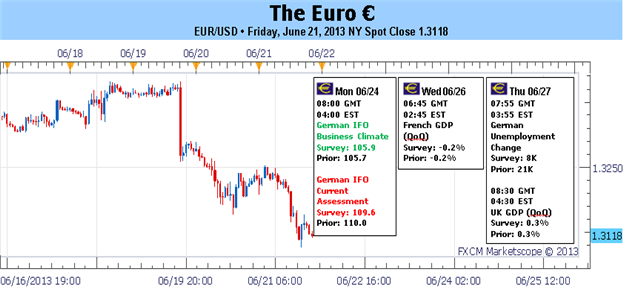
After closing higher against the US Dollar for four consecutive weeks, the Euro’s streak was snapped after it closed the second to last week of June as the third best performer among the majors covered by DailyFX Research. The EURUSD, after briefly topping $1.3400 early in the week, closed the week at 1.3122, down -2.20% from its high on Wednesday. Overall, the EURUSD finished lower by -1.71%, but the late week reversal is the more poignant price action to respect.
Given the recent price action in FX on the whole, it’s not shocking that the Euro remained a top performer. The renewed slide in higher yielding currencies and risk-correlated assets occurred after Wednesday, when the Federal Reserve signaled a slight shift in monetary policy, provoked a massive surge in US Treasury yields. This development has shaken the strength the Euro has found since early-June.
One of the main reasons the Euro has been stronger recently, of course, is due to the European Central Bank choosing to keep its key interest rates on hold at its June 6 meeting, as opposed to implementing a negative deposit rate, which was expected by a small, but significant portion of market participants. Accordingly, as per the most recent CFTC’s COT report (week ended June 18), speculative positioning turned bullish on the Euro, at 20030 contracts, from -84644, the most bullish positioning since the week ended February 19. Evidence is building, however, that this positive sentiment may be short-lived.
In light of the Fed rate decision and announcement that it intends to taper QE3 by mid-2014, anything that solicited attention from the Fed or offered premier return – from US Treasuries to emerging market equities – was hit hard. Our main focus is on Euro-zone peripheral debt of course, which is showing renewed signs of distress. The Italian 2-year note yield hit 1.995% on Friday, its highest level since late-March, and its 20-day rate of change hit +37.2%, the highest since the day after the Italian election when it was +42.7%. Meanwhile, the Spanish-German 2-year yield spread hit its widest levels since April 15. For context, the EURUSD closed that day at 1.3036; the EURJPY closed that day at ¥126.16 (today it closed at 128.15). From this perspective, the Euro still looks a little juiced here, and has some catch up to play with European credit – especially as Japanese bond market volatility remains and US Treasury yields surge higher.
The perfect storm, then, is gathering on the horizon for the Euro-zone crisis to reemerge in all of it glory. There are several irons on the fire right now across the currency union that could provoke the next wave of fear.
In Germany, Chancellor Angela Merkel is going to be increasingly reticent to offer any further fiscal assistance as the September elections approach. In the interim, the German Constitutional Court has to rule on the legality of the ECB’s OMT program, the financial safety net that ECB President Mario Draghi offered as his “whatever it takes” solution to save the Euro, first noted in late-July 2012. With several ECB members and the German government testifying favorably for the legality of the OMT program, it is highly unlikely that the GCC strikes it down, but rather puts a cap on the OMT program – say, €550B, approximately the size of one of the LTROs – which would prove to be Euro negative; sentiment regarding the safety net would be distorted.
In Spain, the country’s debt-to-GDP ratio was revised higher to 88.2%, a record high according to the Bank of Spain. That’s a +19.1% increase from the 1Q’12, when the ratio was 76.2%. Clearly, the government’s measures aren’t working. In France, the economy’s now projected to have zero growth in 2013, as the Unemployment Rate has pulled over 10%; Greek and Spanish Unemployment Rates are north of 25% now, and Youth Unemployment in the Euro-zone has eclipsed 60%.
Speaking of Greece, remember Alexis Tsipras, leader of Syriza and the man who nearly took Greek off the Euro? He’s back and vocal once more, and Greece is edging towards new elections now that the New Democracy-led government is splitting. The New Democracy-PASOK coalition retains only a slim majority to keep pro-austerity leadership in power, now that the junior coalition group the Democratic Left party has dissented.
There are definitely mounting reasons to be cautious on the Euro, and as long as the region struggles to recover, we suspect that the negative rate implementation discussion could jump off the shelf at the ECB, which would present renewed negative pressure on the Euro. This is entirely data dependent, and this week, the mediocre docket shouldn’t do much to bolster the case that the region is starting to improve.
The top event of the week is on Wednesday, when the June German labor market report is released. The economy is expected to have lost -8K jobs, and the Unemployment Rate will have stayed at 6.9%. While this isn’t Euro negative, it isn’t positive either. The other headline event, the preliminary June German Consumer Price Index report, should show higher price pressures over the past year, but disinflation – slower inflation – on the monthly side. The near-term reading is the draw, because it could be a sign of slowing economic activity in the 2Q’13.
With economic data on the whole rather mixed – neither majorly impressive nor disappointing – the Euro is at risk to get sucked into the undertow of the retreating tides of global risk appetite. With storms clouds gathering and the safe havens perking up, attention may turn from emerging markets and the commodity currency bloc to the Euro-zone once more, and we suspect these bearish fundamentals could begin to have their collective impact beginning this week.

To contact Ilesanmi Ogooluwa, e-mail ilesanmiogooluwa@yahoo.com

Dollar’s Best Week in 3 Years Spark for 110 USD/JPY, 1.2000 EUR/USD?

Dollar’s Best Week in 3 Years Spark for 110 USD/JPY, 1.2000 EUR/USD?
By , Chief Currency Strategist
      • Dollar’s Best Week in 3 Years Spark for 110 USDJPY, 1.2000 EUR/USD?
      • Euro Confidence Crumbling as Global Sentiment Suffers, Greece Teeters
      • Japanese Yen: The Bank of Japan is Still Winning
      • British Pound Faces Financial Stability Report, King and Carney Speeches
      • Australian Dollar Suffers Biggest Drop in 15 Months as Bonds Collapse
      • New Zealand Dollar: Will Kiwi Repeat Worst Performer of the Week?
      • Gold Suffers 7 Percent Plunge as Speculative Positioning Hits 7 Year Low
 
  • Dollar’s Best Week in 3 Years Spark for 110 USDJPY, 1.2000 EUR/USD?

    The Fed delivered the global financial markets its biggest shock this past week since the US default brinkmanship resulted in the loss of country’s triple-A rating back in August of 2011. And, the central bank didn’t even change policy. The group’s massive $85 billion-per-month QE3 stimulus program survived the FOMC meeting this past week, yet the 10-year Treasury note was sold heavily enough to drive its yield over 40 basis points higher for the biggest weekly increase in a decade. Meanwhile, the Dow Jones FXCM Dollar Index (ticker = USdollar) rallied 2.4 percent – the strongest move in three years- and the S&P 500 dropped 2.1 percent for its worst performance this year. This revival of risk-appetite based correlations suggests a current of eroding sentiment is carrying us on a market-wide delevering effort that has enough weight to develop a lasting bull trend for the dollar. Yet, does this broad volatility have the necessary elements to send EURUSD back towards 1.2000 or USDJPY up to 110. It is highly unlikely we see both. To send EURUSD plunging 1,000 pips, we will likely need a combination of Euro-area financial risk and general risk aversion (the latter usually instigates the former). Yet, the level of risk aversion to carry the world’s most liquid pairing that far would spur a carry trade unwind for the stimulus-laden yen crosses that sent USDJPY tumbling alongside AUDJPY.
     
    • Euro Confidence Crumbling as Global Sentiment Suffers, Greece Teeters
    The euro is always walking a fine line between controlled, long-term stability risk and immediate crisis. Officials this past week have acted to play down the trouble that has developed in Greece, and desensitized Euro-area investors are tempted to believe that this will be another false threat. Yet, moderate troubles can turn extreme without the help of domestic instability should the broader backdrop for market sentiment deteriorate. European equities suffered the worst weekly performance in 13-months, but the real concern is the sovereign / banking financial trouble feedback. Though still well off 2011 highs as of yet, EU banking sector CDS and Spanish 10-year government bond yields have lurched aggressively higher. In the meantime, Greece’s troubles should not be forgotten. The exit of a government coalition partner speaks to strain in the country that can cause problems with the IMF warning the country on its austerity funding gap.
     
    • Japanese Yen: The Bank of Japan is Still Winning
    Given the exceptional moves for global equities, US Treasuries, high yield currencies and the safe haven dollar; we would look for the Japanese yen to realign to its historical role as a safe haven, funding currency. Yet, through the past week, the yen actually fell against most of its counterparts – and its gains against the pummeled Aussie and Kiwi dollar’s was slight. The Tokyo markets were rocked in the weeks preceding the Taper rout, which no doubt discouraged an inflow of foreign capital looking for haven. With an equity volatility reading twice that of the US and Japanese Government Bonds (JGB) ready to suffer another bout of record swings at any moment, Japan’s financial system is doesn’t present a convincing safe haven backdrop. However, should fear continue to build, the leveraged yen carry trades will take a hit.
       
    • British Pound Faces Financial Stability Report, King and Carney Speeches 
    There was relatively little individual performance from the sterling this past week. GBPUSD tumbled 1.9 percent due to the dollar’s rally while a tumble in risk rallied sunk the commodity bloc (AUD, NZD and CAD) to the sterling’s favor. While there was fundamental fodder to take in, it wasn’t of the cut that can overwhelm a current as deep as risk appetite and Fed stimulus-dependency. We may seen that secondary performance give way to a more active currency in the not-too-distant future however. In the week ahead, a UK Financial Stability Report will likely illuminate the £26 billion funding gap in the nation’s banks noted by the PRA this past week. For monetary policy, outgoing-BoE Governor King is scheduled to testify before the Treasury Committee for the last time; while incoming-Governor Carney hosts the G-20 Financial Stability Board meeting to discuss global regulations.
     
    • Australian Dollar Suffers Biggest Drop in 15 Months as Bonds Collapse
    Having already suffered an exceptional tumble from its ill-fated attempt to overtake 1.0600 just two months ago, AUDUSD made an effort to ensure the tentative rebound from last week was completely snuffed out. The 3.7 percent decline this past week was the worst performance for the pair in 15 months. It would be easy enough to hang responsibility for this move on the greenback, but the malaise in Australian yields shows that the high yield currency is itself suffering. As a carry trade currency, the incredible drop in the10-year government bond – the biggest since 2001 – shows a steady unwinding of yield seekers’ positions. This may seem like a ‘blow off’ move, but putting the 3.76 percent yield into perspective, we were at 5.75 percent in 2011, 6.75 percent in 2008 and north of 10 percent two decades ago.
     
    • New Zealand Dollar: Will Kiwi Repeat Worst Performer of the Week?
    It is easy to be distracted by the Australian dollar’s meteoric plunge through the past two months. However, for this past week, it was the New Zealand dollar that took top spot for worst performer. Until this past week, the kiwi showed a level of restraint to its decline compared to its Aussie counterpart; but recently momentum may indicate a change of scale. The slump in demand for two bond auctions – a 3 percent 2020 bond and local agency debt – confirms the market is losing its appetite for New Zealand yield. We will see a more direct assessment of just how strained the foreign appetite for yield is with the RBNZ’s monthly currency flows assessment due Thursday morning.
     
    • Gold Suffers 7 Percent Plunge as Speculative Positioning Hits 7 Year Low
    There was little reprieve for gold this past week. Though the precious metal fought for a bullish close Friday – the first in five trading days – it hardly made up for the heavy damage incurred throughout the week. The 6.8 percent plunge over the period was the worst since September of 2011. Some may find solace in the relatively restrained volume in both futures and ETFs behind this selloff, but the progress over the last year and current historical level should cut this optimism to realistic levels. A 30 percent drop in nine months to three-year lows gives us proper scope of the situation. Looking at the COT figures (speculative futures positioning through this past Tuesday), the market is most pessimistic on gold since 2006. While this can be considered a contrarian / oversold indication, the complete fundamental shift for the commodity means it is difficult to mount a robust recovery. Given its volatility (bad for a safe haven status) and lack of yield (not a carry), the dollar rebound is painful.


    Euro Biased Lower amid Mixed Docket and Signs of Revived Crisis

    Euro_Biased_Lower_amid_Mixed_Docket_and_Signs_of_Revived_Crisis_body_Picture_1.png, Euro Biased Lower amid Mixed Docket and Signs of Revived Crisis

    By: Ilesanmi Ogooluwa 
    Fundamental Forecast for Euro: Bearish
After closing higher against the US Dollar for four consecutive weeks, the Euro’s streak was snapped after it closed the second to last week of June as the third best performer among the majors covered by DailyFX Research. The EURUSD, after briefly topping $1.3400 early in the week, closed the week at 1.3122, down -2.20% from its high on Wednesday. Overall, the EURUSD finished lower by -1.71%, but the late week reversal is the more poignant price action to respect.
Given the recent price action in FX on the whole, it’s not shocking that the Euro remained a top performer. The renewed slide in higher yielding currencies and risk-correlated assets occurred after Wednesday, when the Federal Reserve signaled a slight shift in monetary policy, provoked a massive surge in US Treasury yields. This development has shaken the strength the Euro has found since early-June.
One of the main reasons the Euro has been stronger recently, of course, is due to the European Central Bank choosing to keep its key interest rates on hold at its June 6 meeting, as opposed to implementing a negative deposit rate, which was expected by a small, but significant portion of market participants. Accordingly, as per the most recent CFTC’s COT report (week ended June 18), speculative positioning turned bullish on the Euro, at 20030 contracts, from -84644, the most bullish positioning since the week ended February 19. Evidence is building, however, that this positive sentiment may be short-lived.
In light of the Fed rate decision and announcement that it intends to taper QE3 by mid-2014, anything that solicited attention from the Fed or offered premier return – from US Treasuries to emerging market equities – was hit hard. Our main focus is on Euro-zone peripheral debt of course, which is showing renewed signs of distress. The Italian 2-year note yield hit 1.995% on Friday, its highest level since late-March, and its 20-day rate of change hit +37.2%, the highest since the day after the Italian election when it was +42.7%. Meanwhile, the Spanish-German 2-year yield spread hit its widest levels since April 15. For context, the EURUSD closed that day at 1.3036; the EURJPY closed that day at ¥126.16 (today it closed at 128.15). From this perspective, the Euro still looks a little juiced here, and has some catch up to play with European credit – especially as Japanese bond market volatility remains and US Treasury yields surge higher.
The perfect storm, then, is gathering on the horizon for the Euro-zone crisis to reemerge in all of it glory. There are several irons on the fire right now across the currency union that could provoke the next wave of fear.
In Germany, Chancellor Angela Merkel is going to be increasingly reticent to offer any further fiscal assistance as the September elections approach. In the interim, the German Constitutional Court has to rule on the legality of the ECB’s OMT program, the financial safety net that ECB President Mario Draghi offered as his “whatever it takes” solution to save the Euro, first noted in late-July 2012. With several ECB members and the German government testifying favorably for the legality of the OMT program, it is highly unlikely that the GCC strikes it down, but rather puts a cap on the OMT program – say, €550B, approximately the size of one of the LTROs – which would prove to be Euro negative; sentiment regarding the safety net would be distorted.
In Spain, the country’s debt-to-GDP ratio was revised higher to 88.2%, a record high according to the Bank of Spain. That’s a +19.1% increase from the 1Q’12, when the ratio was 76.2%. Clearly, the government’s measures aren’t working. In France, the economy’s now projected to have zero growth in 2013, as the Unemployment Rate has pulled over 10%; Greek and Spanish Unemployment Rates are north of 25% now, and Youth Unemployment in the Euro-zone has eclipsed 60%.
Speaking of Greece, remember Alexis Tsipras, leader of Syriza and the man who nearly took Greek off the Euro? He’s back and vocal once more, and Greece is edging towards new elections now that the New Democracy-led government is splitting. The New Democracy-PASOK coalition retains only a slim majority to keep pro-austerity leadership in power, now that the junior coalition group the Democratic Left party has dissented.
There are definitely mounting reasons to be cautious on the Euro, and as long as the region struggles to recover, we suspect that the negative rate implementation discussion could jump off the shelf at the ECB, which would present renewed negative pressure on the Euro. This is entirely data dependent, and this week, the mediocre docket shouldn’t do much to bolster the case that the region is starting to improve.
The top event of the week is on Wednesday, when the June German labor market report is released. The economy is expected to have lost -8K jobs, and the Unemployment Rate will have stayed at 6.9%. While this isn’t Euro negative, it isn’t positive either. The other headline event, the preliminary June German Consumer Price Index report, should show higher price pressures over the past year, but disinflation – slower inflation – on the monthly side. The near-term reading is the draw, because it could be a sign of slowing economic activity in the 2Q’13.
With economic data on the whole rather mixed – neither majorly impressive nor disappointing – the Euro is at risk to get sucked into the undertow of the retreating tides of global risk appetite. With storms clouds gathering and the safe havens perking up, attention may turn from emerging markets and the commodity currency bloc to the Euro-zone once more, and we suspect these bearish fundamentals could begin to have their collective impact beginning this week.

To contact Ilesanmi Ogooluwa, e-mail ilesanmiogooluwa@yahoo.com

Forex Market New Update

Dollar’s Best Week in 3 Years Spark for 110 USD/JPY, 1.2000 EUR/USD?
By , Chief Currency Strategist
      • Dollar’s Best Week in 3 Years Spark for 110 USDJPY, 1.2000 EUR/USD?
      • Euro Confidence Crumbling as Global Sentiment Suffers, Greece Teeters
      • Japanese Yen: The Bank of Japan is Still Winning
      • British Pound Faces Financial Stability Report, King and Carney Speeches
      • Australian Dollar Suffers Biggest Drop in 15 Months as Bonds Collapse
      • New Zealand Dollar: Will Kiwi Repeat Worst Performer of the Week?
      • Gold Suffers 7 Percent Plunge as Speculative Positioning Hits 7 Year Low
 
  • Dollar’s Best Week in 3 Years Spark for 110 USDJPY, 1.2000 EUR/USD?

    The Fed delivered the global financial markets its biggest shock this past week since the US default brinkmanship resulted in the loss of country’s triple-A rating back in August of 2011. And, the central bank didn’t even change policy. The group’s massive $85 billion-per-month QE3 stimulus program survived the FOMC meeting this past week, yet the 10-year Treasury note was sold heavily enough to drive its yield over 40 basis points higher for the biggest weekly increase in a decade. Meanwhile, the Dow Jones FXCM Dollar Index (ticker = USdollar) rallied 2.4 percent – the strongest move in three years- and the S&P 500 dropped 2.1 percent for its worst performance this year. This revival of risk-appetite based correlations suggests a current of eroding sentiment is carrying us on a market-wide delevering effort that has enough weight to develop a lasting bull trend for the dollar. Yet, does this broad volatility have the necessary elements to send EURUSD back towards 1.2000 or USDJPY up to 110. It is highly unlikely we see both. To send EURUSD plunging 1,000 pips, we will likely need a combination of Euro-area financial risk and general risk aversion (the latter usually instigates the former). Yet, the level of risk aversion to carry the world’s most liquid pairing that far would spur a carry trade unwind for the stimulus-laden yen crosses that sent USDJPY tumbling alongside AUDJPY.
     
    • Euro Confidence Crumbling as Global Sentiment Suffers, Greece Teeters
    The euro is always walking a fine line between controlled, long-term stability risk and immediate crisis. Officials this past week have acted to play down the trouble that has developed in Greece, and desensitized Euro-area investors are tempted to believe that this will be another false threat. Yet, moderate troubles can turn extreme without the help of domestic instability should the broader backdrop for market sentiment deteriorate. European equities suffered the worst weekly performance in 13-months, but the real concern is the sovereign / banking financial trouble feedback. Though still well off 2011 highs as of yet, EU banking sector CDS and Spanish 10-year government bond yields have lurched aggressively higher. In the meantime, Greece’s troubles should not be forgotten. The exit of a government coalition partner speaks to strain in the country that can cause problems with the IMF warning the country on its austerity funding gap.
     
    • Japanese Yen: The Bank of Japan is Still Winning
    Given the exceptional moves for global equities, US Treasuries, high yield currencies and the safe haven dollar; we would look for the Japanese yen to realign to its historical role as a safe haven, funding currency. Yet, through the past week, the yen actually fell against most of its counterparts – and its gains against the pummeled Aussie and Kiwi dollar’s was slight. The Tokyo markets were rocked in the weeks preceding the Taper rout, which no doubt discouraged an inflow of foreign capital looking for haven. With an equity volatility reading twice that of the US and Japanese Government Bonds (JGB) ready to suffer another bout of record swings at any moment, Japan’s financial system is doesn’t present a convincing safe haven backdrop. However, should fear continue to build, the leveraged yen carry trades will take a hit.
       
    • British Pound Faces Financial Stability Report, King and Carney Speeches 
    There was relatively little individual performance from the sterling this past week. GBPUSD tumbled 1.9 percent due to the dollar’s rally while a tumble in risk rallied sunk the commodity bloc (AUD, NZD and CAD) to the sterling’s favor. While there was fundamental fodder to take in, it wasn’t of the cut that can overwhelm a current as deep as risk appetite and Fed stimulus-dependency. We may seen that secondary performance give way to a more active currency in the not-too-distant future however. In the week ahead, a UK Financial Stability Report will likely illuminate the £26 billion funding gap in the nation’s banks noted by the PRA this past week. For monetary policy, outgoing-BoE Governor King is scheduled to testify before the Treasury Committee for the last time; while incoming-Governor Carney hosts the G-20 Financial Stability Board meeting to discuss global regulations.
     
    • Australian Dollar Suffers Biggest Drop in 15 Months as Bonds Collapse
    Having already suffered an exceptional tumble from its ill-fated attempt to overtake 1.0600 just two months ago, AUDUSD made an effort to ensure the tentative rebound from last week was completely snuffed out. The 3.7 percent decline this past week was the worst performance for the pair in 15 months. It would be easy enough to hang responsibility for this move on the greenback, but the malaise in Australian yields shows that the high yield currency is itself suffering. As a carry trade currency, the incredible drop in the10-year government bond – the biggest since 2001 – shows a steady unwinding of yield seekers’ positions. This may seem like a ‘blow off’ move, but putting the 3.76 percent yield into perspective, we were at 5.75 percent in 2011, 6.75 percent in 2008 and north of 10 percent two decades ago.
     
    • New Zealand Dollar: Will Kiwi Repeat Worst Performer of the Week?
    It is easy to be distracted by the Australian dollar’s meteoric plunge through the past two months. However, for this past week, it was the New Zealand dollar that took top spot for worst performer. Until this past week, the kiwi showed a level of restraint to its decline compared to its Aussie counterpart; but recently momentum may indicate a change of scale. The slump in demand for two bond auctions – a 3 percent 2020 bond and local agency debt – confirms the market is losing its appetite for New Zealand yield. We will see a more direct assessment of just how strained the foreign appetite for yield is with the RBNZ’s monthly currency flows assessment due Thursday morning.
     
    • Gold Suffers 7 Percent Plunge as Speculative Positioning Hits 7 Year Low
    There was little reprieve for gold this past week. Though the precious metal fought for a bullish close Friday – the first in five trading days – it hardly made up for the heavy damage incurred throughout the week. The 6.8 percent plunge over the period was the worst since September of 2011. Some may find solace in the relatively restrained volume in both futures and ETFs behind this selloff, but the progress over the last year and current historical level should cut this optimism to realistic levels. A 30 percent drop in nine months to three-year lows gives us proper scope of the situation. Looking at the COT figures (speculative futures positioning through this past Tuesday), the market is most pessimistic on gold since 2006. While this can be considered a contrarian / oversold indication, the complete fundamental shift for the commodity means it is difficult to mount a robust recovery. Given its volatility (bad for a safe haven status) and lack of yield (not a carry), the dollar rebound is painful.